
Comments
-
What do you think of the traditional past performance model?
According to a quick internet search it is the same product. Good job Tom -
What do you think of the traditional past performance model?Not familiar with Equisim Ranch. I remember a sheet like product that a friend of mine used. If memory serves me correctly it was owned by Cary Fotius. It incorporated pace into the final numbers. It was named Equi 'something' lol
-
What do you think of the traditional past performance model?Has anyone ever tried Thorograph? Can you offer any comments on the layout and the data presented? How do you deal with pace in the product? Just curious
-
What do you think of the traditional past performance model?
Dave, I can't say that I do like the plot approach. I just presented it as an alternative to RanchWest topic here. The position of the squares and circles are based on numeric ratings. The product suite also presents the numeric data in a spreadsheet. -
RS out of PreaknessIMO- it's hard to criticize a trainer for opting to give a horse a little more rest between starts, especially if they fully intend to run him back in a few more weeks. I applaud having the guts to skip the Preakness when industry pressure exists.
From a fans and Pimlico's perspective it would be great to have an opportunity for a Triple Crown winner. -
What do you think of the traditional past performance model?Team,
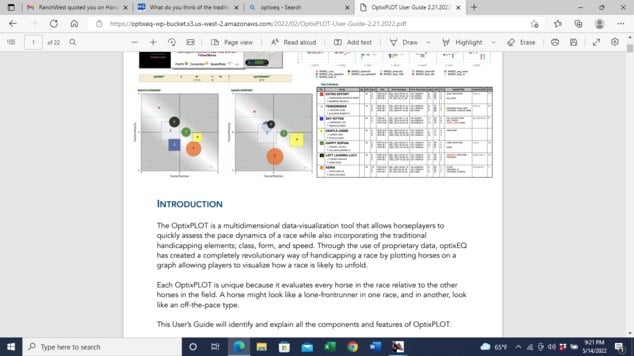
I did a little research and found this on the OpTixEQ website. It provides an alternative view of PP data.
-
What do you think of the traditional past performance model?
Tom- I looked at something similar years ago in BRIS. I believe that when you edit a style you can select what to display on your PP's including some user defined fields. I honestly didn't give it a good effort as I didn't want to move away from the DRF PP's. If you have the PP Generator you can probably look it up. -
What do you think of the traditional past performance model?I came across a product named OpTix which is to present an alternative to traditional handicapping. I took a brief peek at it once but never really spent time researching it. If I recall it plots the projected positions of all runners in a graph of sorts. Looked like an alternative to traditional PP's
-
What do you think of the traditional past performance model?Wow!! Great topic Ranch.
You guys are so sophisticated and have developed some amazing aids. It's no coincidence that you all found your way to Dave. I'm especially impressed by the way you've incorporated colors into your PP's. By themselves they almost add an additional layer into the PP's. They could be used to quickly identify the best early, late and class factors in a race. And many others I'm sure. Helps to deal with the one horse at a time quandary.
Let me say that I am a traditional PP guy. I print, markup and read the PP's just as my father did. I like a race to print on no more than 2-3 pages. I've accepted the traditional one horse at a time model. Some of my quirks may be positive and some I'm sure are limiting.
Comments:
Ranch:
Ranch merging workout lines in the PP"s has always intrigued me. This can be done in Formulator and probably other products. However, I've found my 'vision' when reading the PP's is interrupted so to say. It's like my visual method of reading and absorbing the PP data is broken. I know I'm missing helpful data here but I can't seem to find a comfortable and concise way to get around it. Great use of colors!
Jack:
Very impressive Jack. You've rolled up the PP lines into a pretty concise summary. I like the way pace pressure is identified on the page. At first glance I like it a lot.
Tom:
Let me first say that Tom is one of my all- time favorite posters. His work on PA and here is so valuable and often times hilarious. Tom I love the way you took products available at no or very little cost and made them more useful! I've always known these features were there but I've been too stubborn to investigate them.
This is a great topic. Hopefully I'll be able to contribute something to it. -
What being a member here has done for me
Steven, we are all works in progress. Don't get discouraged!! -
Fellow Won the Derby Trifecta with ALL button - Does that count?Not the only story I heard like that today. Although I couldn't see the ticket well enough to determine exactly was bet I was made aware of 2 friends the keyed Zandon and Epicenter on the board wheeling the balance of the field in the first 3 holes. They made nice scores and I can't knock them. Well done.
-
The Work BeginsThe one positive aspect to 'big race days' at the track is large betting pools. With a little creativity and a lot of luck sizeable P5's loom. The all stakes P5 at CD this year includes race 8 thru 12. I'm looking at 2 potential singles (Race 8 and 10) and then spread in the remaining races hoping for some value.
In race 8 I will try to beat Just One Time who is bred and still partially owned by some friends of mine. I've watched her train many times and she is the real deal. But she is a bit fractious near the gate and that may bite her one of these races. She will probably start with a blanket in the gate.
I'm getting good vibes from Bell's The One who figures to go post at odds of 4-1, making her a good single.
In race 10- Jackie's Warrior will prove difficult to catch. His main rivals will need help from someone to soften him up and that scenario does not look likely. Jackie is the probable favorite but we only need one decent winner to sweeten the ticket -
Paceline Selection Systems & MethodsBTW, HSH does have built in Rag-style numbers.
Do you like those? — Dave Schwartz
I've always felt that the precision in the Thorograph numbers was amazing. I'm comfortable that the adjustments made to the numbers (wide trips, weight on/off, wind) were appropriate and added value. With a little practice, the presentation of the figs in graphs was good for my eye. I felt I could see both obvious and subtle improvements and regressions in a horses form. Key distinction is that I compared a horses recent form with his past form to determine where they may be in their form cycle.
I don't recall reviewing SLT in HSH so a comparison is difficult. I'm not sure what 'number' is used to build the HSH sheets. Could you please add a little detail for me?
I'll address the paceline process soon but right now I'm preparing for Belmont -
Paceline Selection Systems & Methods
Experience does help. But I'd have to say that my experience with Thorograph played a big part. Especially the concepts around form cycles -
What being a member here has done for meRanch- thank you for sharing your experience. I have had a similar relationship with Dave for 30 years. He's sharp and always willing to help and share. I have a feeling that 30 years from now I'll be saying the same things about you!!
-
Paceline Selection Systems & Methods
It can be done through HSH. I did it using ThoroBrain in the past. It's a pretty subjective process for me right now. -
What about jockeys?
Dave, in my experience most trainers provide riding instructions to jocks. Sometimes owners even enter the conversation. For the most part jocks do what they can to follow the instructions but when gate opens the best laid plans often get derailed.
In the mid 1980's I was part of a paddock conversation between jockey Rudy Aviles (high percentage jock) and a 25% plus trainer whom I'll leave unnamed. The trainer got a little carried away and gave what felt like was 5 minutes of instructions. After listening to the instructions Rudy looked at the trainer and said, Steve you train 'em and I'll ride them. The trainer was speechless. Needlesstosay Rudy steered his mount home 5 in front. I don't believe I ever heard this trainer provide instructions again.
I do not represent any jockeys today. I would definitely consider it if I spotted the right rider. It actually is a nice compliment to wagering. In fact I have been pursuing a young apprentice rider currently taking calls at Indiana Grand. I watched her work horses at GP when she was just starting to ride. This young lady has the tools to enjoy a prosperous apprentice year. Her name is Gage Holmes, keep an eye on her. She's currently won 3 out of 45 races but she's been riding longshots for the most part. I expect her to have a big year. -
Paceline Selection Systems & MethodsI find that usually use 3 pacelines each weighed a little differently based on the way I feel the form cycle is moving. This is a great thread
-
Is bias real?Ranch- seriously well thought out group of questions. Thank you!! Here are a few thoughts from my perspective.
But in studies of topics other than bias, we usually talk in terms of a very minimum of 30 wins before we consider there to be any trend. So, why do we look at such a small sample of bias when that is contrary to our normal habits?
By definition, bias is a disproportionate weight in favor of or against something. I suppose that if a bias held up over a larger sample size it would become the norm and lose much of the value it may offer. That being said, I view horse racing as a cyclical game and I'm always looking for 'short term' trends that may offer value. For me a handful of races may be more than enough.
I utilize a similar mindset when betting 'hot' trainers. I'm looking for trainers that win 2 or 3 of their last 4 or 5 races, not 12 of their last 30. My belief is that value is more prevalent in short term trends
Tony Kofalt

Start FollowingSend a Message